12 July 2009

Project Assessment Trek: Grand Bassa and River Cess

A bit over a week ago, we went on our second trek to check out two more of the six pilot counties involved in our project. This was supposed to be a longer trek, but ended up only being 2 days, 1 night, because the other team members were set on getting back to Monrovia as soon as possible (…even if it meant not doing as thorough a job as we should have...). Anyway, lots of driving down crazy unpaved roads in the dark, always safe and always fun. I kept some notes on during the trip and I think they’ll be able to say more and capture the mood in their original form much better than my verbose rhetoric will. It's a bit stream-of-conscious . . .

A quick overview – I’m going out to 6 villages in 6 different counties to do project assessments for a joint MIA/UNDP project that is aimed at increasing local governance capacity and advancing the goals of decentralization. So, here’s how the trip went down:

River Cess, 29 June 2009

Meetings: difficult/challenging but good!

Highly political - Informal market - Focus on technical - Walked to see sites – cool

Cestos = fishing village, cold storage = big deal

Rain came – heavy - Took refuge in church – took pics of heavy rain

Noticed what looked like a body lying in a dark corner

Was not convinced alive…but moved.

Woman.

Soiled lappa [skirt].

Laying facing wall

Me: Is she ok?!?

She’s sick, here for spiritual healing.

Me: Sick in the mind or the body?

In the body.

Me: So we just leave her?!?

Yes.

Cold Storage – very logical for fishing community

Ate lunch like starving

Felt terribly hungry – shaking.

Devoured entire plate: rice, eggplant, fish. Left only bones.

Worm?

Meds amy gave me for running stomach = lifesaver!!! [spent weekend sick with running

stomach, pain, fatigue, but meds cleared it all up]

Super Star Boat – US$2,500

Ghana – few days drive on river, not difficult

On the way here, team members kept saying road was terrible.

But not as bad as South Bank road in the Gambia. Would actually be considered a better road in The Gambia

Woman just came in and covered sick woman with a fresh lappa.

Matta – cool woman, in cold storage focus group, not “educated” but SMART.

Asked by David: Are you married to an educated man?

Matta's Answer: Yes, my first husband, before the war killed him, he was a medical

doctor.

Hiding in church from rain, 1 hour now. . .

Backtracking: Cold Storage Meeting

Got lots of info, frustrating at times

Lendeh – knows technical stuff well but told me I was “too interested in the economic side” – funny because I am NOT an econ person

Just want to actually justify projects and make sure they’re a good idea by lookin at REAL numbers. . . So hard to get real #s though . . .informal markets

Also, community members look at me and tell me higher prices because white denotes money

Original cost of canoe – US$15,000 – after other community members raised alarm, price revised to US$2000. Some people are honest!

Escaped church. . . Ankle deep in H2O. . .18:15 but where are we going to sleep?!?

The place we were supposed to sleep at got burglarized last night . . .

Buchanon. [a bigger town about 3 hours from Monrovia]

Found place to sleep

Smells like urine and bug spray.

Went to get beer with the old boys.

Hooker bar. Bakini’ed women painted on the walls. So loud music it was un-hearable, one Michael Jackson tribute song on repeat.

Didn’t finish beer.

Back to motel, confused how I end up in some places sometimes.

Sat and chatted with other team members in “lobby”

Chatting ended when ------- came home with women. Two.

Wanted to stab little man with sharp things. Disgusted/embarrassed.

Do what you want to do, but I don’t want to see it. Esp. older, married men.

Lame.

Bedtime.

Now horrified that this is a whore house

Old man Lendeh is vexed about the hookers – he was supposed to share room

with -----. I don’t blame the old man! I’d be livid. . .

I hear arguing in hallway, hookers leaving.

Not very long deh!

Can’t bring self to lay down in nasty bed.

Stood in room and took self portraits for 1.5 hours. What else can I write about….

Backtracking – the ride from Cestos to Buchanon was terrible

Road seemed MUCH worse at night. Tried to sleep

Seat didn’t recline

Felt car sick.

Also thought I was having a heart attack. Maybe just indigestion? Or OD'ed on

Amy’s stomach medicine?

2.5-3 hours in dark, bumpy, tired, dizzy, indigested, chest-painy, kept leaning

head on hand then punching self in face when we hit bumps. Often.

Tried deep breathes and happy thoughts.

Survived.

NOW exhausted. About to pass out. Sitting on side of nasty bed. Baby steps. Smell of urine has subsided – or I’ve adjusted.

Mosquito nets has holes. Wonder how much this place will cost me?

Grand Bassa, 30 June 2009

Sitting in a tea shop – owned by Fula men. Love breakfast of tea and bread.

3 motorcycles parked in front of a huge puddle as a parade of Buchanon Renewables 18- wheelers, honking and waving to people. New trucks. Shiny and Off to Monrovia.

Jumped in UNDP car, made good time to Desoe town – here by 11.

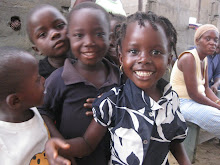
Toured town, chatted, took pictures with kids, men, women, chatted more. 12. 1. 2. still now the other car has not arrived. But no network to call them.

Not sure where they are.

Want to start meeting – but everyone else thinks we should wait for the other car. It’s been hours.

But village is bereaved. Old man died last night. They want to get on with their lives.

I started the meeting at 2:30. We arrived at 11. I think we waited ample. After 45 minutes they show up, annoyed that we started without them – they were carrying the Commissioner. Politics. Silly.

Meetings went well but we should have stayed longer to be more thorough .. .. .. big rush to get back to Monrovia. In UNDP car again - made it back to Monrovia by 10:30 . . . the other car got stuck, had to stay in whore house again. Ha. Glad i wasn't there. . . . . . .

03 July 2009

The Death of the King of Pop in Post-War Liberia: Surprisingly Traumatic

When I first heard about Michael Jackson’s death, I took it with detached sadness. Being out of the media mix that is America, I’m not inundated with constant updates about the details surrounding his death, the possible funeral plans, his attitude at his final rehearsal. And that’s nice. Of course, I remember Michael Jackson fondly – excluding the shadiness and the increasing creepiness of his later years – he was a true rock star. We had every possible cassette tape you could own with a Michael Jackson song on it. Our Oldsmobile Cutlass Sierra complementary cassette tape was my first introduction to Man in the Mirror, and I distinctly remember being struck by the words each morning, buckled against the gray interior, surrounded by the “new car” smell, decked out in my plaid Catholic school uniform and grasping my oversized cooler/lunch box my mom made me carry (despite the fact that I got teased daily and pleaded with her each morning to just give me a brown paper bag). I still love rocking out to that song while driving. It’s an amazing song! All his songs – Man in the Mirror, Bad, Black or White, Heal the World – these songs were the odd but beautiful soundtrack of childhood growing up in America in the 80s and 90s. And so, yes, hearing that Michael Jackson is dead is rather sad, but being here in Liberia and missing the frenzy makes it almost surreal.

A surreal-ity which is only increased by the deep, deep sadness with which Liberians took the news. The Daily Observer, one of the country’s biggest newspapers, ran a full front page photo of MJ the day after the news broke. I heard a story about a Liberian newscaster reporting the story and breaking down on TV. Grown men and women cried in offices. A Liberian without access to internet gave me a note asking me to print anything I could about the death of Michael Jackson. The love that Liberians have for this man is striking. I didn’t expect people to even know about it, let alone mourn over it in a nation that has experience far greater tragedy than the death of a pop star.

There’s no mention of the legal problems, of the issues with children, of his strange and erratic behavior (I’m assuming that comes up in the US media, does it?). But here, he is just a pure and fantastic musician. Not a guy with a sad and tortured past, not a guy who’s clearly got some issues – but a man who can sing and dance and engage people and who is loved simply because of that. And also because of one particular song: Liberian Girl. It’s not one of his most popular in the states, but it gives him knightly status here in Liberia.

In an article in the Washington Times, a woman in Ganta, Nimba County – an area that experienced heavy fighting during the war and is a full day’s ride from the capital, talks a little bit about the impact of MJ’s Liberian Girl (ironically, a song that wasn’t even about/related to Liberia, as you’ll read…):

“ ‘When that music came out ... the Liberian girls were so astonished to hear a great musician like Michael Jackson thinking about a little country in Africa,’ Mrs. Carson said. ‘It gave us hope, especially when things went bad ... . It make us to feel that we are still part of the world.’

Mr. Jackson’s music video of “Liberian Girl” doesn't indicate the song was for or about Liberia. It begins with supermodel Beverly Johnson chanting in Swahili, a native language of East Africa. Liberians speak English. The video includes appearances by nearly 40 celebrities, including Paula Abdul, Danny Glover, Whoopi Goldberg, Olivia Newton-John and Steven Spielberg.

But what matters to Liberians are the lyrics: ‘Liberian Girl, you know that you came, and you changed my world ... I love you, Liberian Girl.’

‘The song promotes Liberian women and makes her feel good to be one,’ Mrs. Carson said. She has four daughters, who she hopes will become successful in a postwar Liberia still rife with many obstacles – including an 80 percent unemployment rate and an education system that still is recovering from years of civil war.”

For the full text of the article: http://washingtontimes.com/news/2009/jul/02/king-of-pop-uplifts-liberia/

This from the Daily Observer, in the obituary section, surrounded by the names and stories of regular Liberians:

King of Pop, Michael Jackson Is Dead

Published: 26 June, 2009
Los Angeles -- Authorities have confirmed the death of Michael J. Jackson. News broke Thursday afternoon that the star had called emergency services and had been rushed to the hospital, having suffered cardiac arrest.

Half an hour later, it was reported that he was in a coma. Shortly thereafter, credible sources reported he had died. He was 50. Medical minds say as many as 50 causes can lead to cardiac arrest, and that the care a patient receives in the immediate aftermath is critical.

In a brief but emotional press conference held by the family, Jackson's brother Jermaine revealed that Jackson's attending physician was present at the time he suffered the arrest, but that an hour-long effort to resucitate him had proved fruitless. An autopsy is underway.

Liberians will certainly miss the King of Pop, remembering him especially for his 1987 single, "Liberian Girl" from the album Bad. Jackson fans the world over are mourning his loss.

Funeral arrangements have yet to be announced by the family.

Website:http://www.liberianobserver.com/news/fullstory.php/aid/17119/King_of_Pop,_Michael_Jackson_Is_Dead.html

28 June 2009

Black Man’s Wish

A few weeks ago, Saypah was telling a story about a woman who got raped by a chimpanzee. I know, incredibly random. But also striking – was this a story that she heard growing up, or something that was told during/after the war? Rape was so common here during the war, and is still a huge problem – we’ve heard a really wide range of estimates on the number of women who have experience sexual abuse, ranging from 33% to 75%, but the fact remains: a large number of women in Liberia have been the victim of some sort of sexual abuse. It seems logical that stories like this are the result of the years and years of conflict. They have to be. It was interesting because she told this story with all the kids listening, the idea of “rape” wasn’t something she hid from them. Basically, a woman has a pet chimpanzee, but as it grows up it gets tooooo strong and toooo big. One day, the chimp rapes her and she gets pregnant. Her husband has been dead for a long time, so many people in the village are whispering and there are many rumors. The woman is scared that the baby will be deformed but it’s a nice little boy and he grows up happy and healthy, but never knows who his father is.

He takes a wife and she gets pregnant. When she has the baby, it’s a chimpanzee. The nurses at the hospital are scared, so they kill it and tell the couple the baby just died. The same thing happens a second time. Then a third. On the fourth baby the nurse decides she has to say something, so she calls the man in and tells him, “Look. Your baby is a chimpanzee. All the others were too but I killed them.” And the man was veeeery angry, so he went to his mother and demanded to know who his father was, and the mother tried to lie and lie, but she knew that she had to tell him. So she told him what the chimpanzee did to her and the son grew very angry, very very angry. He went to the chimpanzee and he killed it. Then he killed his mother. Then he killed himself.

Seriously, that’s how the bedtime story ended. I was like, “Ummmm, well, wow.” What do you say to an ending like that?!? I mean, that has to be a remnant of war: a horrible story with a theme of rape and murder? I just listened, I don’t want to butt in and say, “No, that’s impossible. This is biologically impossible.” Maybe I should have – the kids are listening and “learning” . . .but I don’t know, she was so emphatic, and she believed it so much. She’s quite a good storyteller actually, it’s just that this story was so jarring.

After a little reflective silence, Saypa continued, “You see, the black man is always destroying. That is his wish. But white man’s wish put ship on the water. White man’s wish put plane in the sky. White man’s wish made the radio talk. White man’s wish put submarine under the sea. Black man’s wish is to destroy. Black man’s wish is to kill small children. Black man’s wish is bad.”

Wow, wow, wow. What do you say to that? No! Not all Africans want to destroy! Not all Africans want to kill! Most don’t! At all! But what do I know? She was the one who lived through war, who witnessed the murder and rape of her family and friends. I can tell her she’s wrong, I can tell her that human-chimp babies are biologically impossible, I can tell her that the “black man’s wish” is not to destroy, I can tell her there are many “white man’s wish”-es that are bad and wrong and destructive, I can tell her these things but I really don’t know what it will accomplish.

It’s hard to imagine what this country was like without war, before war. It comes up suddenly, in simple conversations, sometimes in matter of fact tones, sometimes tones of sadness, sometimes tones of pride: I survived. Matthew, who works in the Peace Building Unit with Thorodd, my classmate from Georgetown, drove us to work a couple times. One day, we were simply driving, chatting about mundane things one minute and then suddenly the conversation shifts to the day he had to flee to Cote d’Ivoire and almost died on the way: “When we crossed the border, we were so happy. Covered in mud. No clothes. But it was the happiest feeling ever.”

At the soccer game last week (more on that at some point. . .), my friend Javi met and talked with some ex-combatants. Javi can certainly tell the story better and in much more detail (my roommate Jenny and I are hoping he’ll write something to put up as a guest post, though it might be in Spanish….). Basically the boys were 24 years old – making them about 18 when the war ended. Making them incredibly young when the war started. They told him about doing/being forced to do cocaine, heroin, and pot as seven-year-olds and then going out to kill people. Javi talked about their scars – bullet wounds, large cuts, needle marks – which they showed him. The one guy was in Chucky Taylor’s Anti-Terrorist Unit (ATU). Chucky is insane – he grew up in Orlando but later joined his infamous father, Charles Taylor, in Liberia. If you want a better idea of what this young 24-year-old probably witnessed/participated in, and how Chucky Taylor went from Orlando to his father’s stronghold in Gbarnga (the town I’ve visited a few times…) to being the commander of a security unit known for its utter brutality, and just to get a better sense of what child soldier/ex-combatants went through, and what Liberia was like during the civil war – read this article:
http://www.rollingstone.com/news/story/22828415/american_warlord/2

Hearing Javi tell the story – the point he made that was most intense was the fact that this 24-year-old kept saying, kept wishing, with anger rising in his voice, “But that life is over! I want a happy life! I want a happy life!” He’s 24. He can’t go back to his village because the people know what he did. The police know him. He’s marked as a killer. As Javi put it: “They not only stole his childhood away from him. They stole his entire life.” Parts of everyone’s life were stolen – from the victims, from the ex-combatants, from the people that fled to Guinea, Sierra Leone, Cote d’Ivoire, and the US. And it always comes up. It didn’t go away when Ellen got elected: all the underlying tensions are still in place and hearing Javi talk about his encounter with that 24-year-old, it just highlights how tenuous the peace actually is. There is a whole population of fighters here (who were often victims as well), and there’s a whole population of straight-forward victims – and there aren’t jobs, and there aren’t strong local governments….but the commanding structures of these militias are still in place. Yet on the surface, it’s a peaceful country, it’s moving forward, there’s hope. But there can’t be any of those things if you’re not addressing the needs of people who wish for happy lives but who have been branded as life-long killers.

There are definitely programs and initiatives going on – Thorodd just visited an agricultural center in Nimba County that works extensively with ex-combatants. They go out in to communities and talk to them about whether or not they will accept reformed soldiers back. Meanwhile, they are training these former soldiers in a 4-month agricultural skills training program. If they successfully complete the program, they’re given some capital to start their projects and then sensitively reintegrated into the host communities. I’m really not sure how “sensitive reintegration” works on a practical level. . . but I’m hoping to get up there and visit the center at some point.

So, the black man’s wish vs. the white man’s wish. I should have told Saypah she was wrong. When Charles Taylor and Chucky were around, people just needed to survive, a lot of the killers were children! A seven-year-old forced to do drugs and shoot family members isn’t making a choice. And once you’re forced to do that: what else is left to do but keep killing? Charles Taylor’s Presidential campaign slogan speaks volumes: “He killed my Ma. He killed my Pa. But I will vote for him.” In a country where this mentality has been instilled in a large portion of the population, there’s no capacity to wish. The actions Saypah witnessed weren’t the “black man’s wish” in Liberia. Everyone just wanted to survive, the wish is now – to move on, to have a happy life. The challenges are so vast though, it’s hard to imagine the wish coming true for so many in a generation of victims and fighters.

27 June 2009

NO PHOTOGRAPHY apparently means NO PHOTOGRAPHY

I was so smug. I knew I wasn’t supposed to take pictures, but I really wanted a picture of the seal: UNITED STATES EMBASSY MONROVIA. It’s pretty and rather colorful and just begging to be photographed. And I got two good ones. I would show you the picture so you could see how pretty the seal is, but they were both deleted by an Embassy Official. I was so proud of myself too, chuckling as I walked away with my pictures in tow. So smug. Ha! No photography! Whatever, Embassy. I was on my way to meet Kristen from Gbarnga, in town for a couple days, for dinner. I was actually looking out at the ocean as I walked, thinking about the mixed reviews I had heard about Monrovia before coming – and musing over its harshness and beauty. There’s filth and beauty and the dirty aspects just make the pretty aspects even more pronounced. I was in my own little world thinking about juxtaposition, still smug about my pictures. Then I heard the guard behind me telling me to stop. I thought about running, but then thought – eh! Me! I can talk my way out of this.

The guard would have none of my talking. He could have cared less. And made me walk all the way back to the main gate. After he shot down my initial attempt to talk my way out of it, I wanted out of the game. I told him I would just delete the pictures in front of him, but he insisted I go see his supervisor. Awesome. I really wasn’t in the mood, and was pretty indignant. These are my excuses for being mildly bitchy: fatigue from my field assessment that day, filth from the sweat and travel, the fact that I was dropped off at the wrong hotel and had to walk 20 minutes to the right one, with ominous stomach irritation. I should have just kept my mouth shut – I mean, the guard was doing his job to protect my country’s Embassy, I shouldn’t be a jerk. But really – the seal? Why on earth would you paint such a pretty seal and not let people take pictures of it!? He didn’t answer me when I posed this question.

His supervisor wasn’t very nice to start. And I actually tried to be nicer to him. The supervisor takes down all my information and then says, “Isn’t this the second time we’ve stopped you?” Absolutely not, though I had previously taken an illegal picture of the embassy without getting caught (see above). So this guy proceeds to call his supervisor. And I wait outside the embassy for a couple minutes with guard #2. I realize I am being not friendly, but at this point it seems pointless to fix it. Then a young State Department guy emerges and asks, “Took a picture?” Yeeeep. I was pretty annoyed with myself because I then proceed to have an amicable conversation with this guy after being annoyed with the guards, who are, again, simply doing their jobs. That wasn’t very cool, I know. I tried to apologize with handshakes but they had had enough of me. To be honest, they were a little too seriously for the offense committed, but again, doing their jobs. Thank for you protecting my embassy, Guards.

Anyway, the State Dept. guy, Nick, takes my passport info, deletes the two pictures I took, and then explains that the expat embassy community is really small, and they are always looking for new people to hang out with. So, got detained AND got on the embassy email list for Embassy/Marine parties. Toga party, July 18th. Oh the randomness of being an ex-pat.
Posted by Picasa

Slash and Burn Agriculture

Project Assessment Day Treks

Last week, I went to Beajah, Bomi County and Gbarma (not to be confused with Gbarnga), Gbapolu County. We went out and met with community members to assess potential projects in the counties. I’m working with the County Development Support Secretariat (CDSS) within the Ministry of Internal Affairs (MIA). CDSS works along with Liberian Decentralization and Local Development (LDLD), which is a joint MIA/UNDP (United Nations Development Program) effort to increase the capacity of local government and community structures. There are 15 counties within Liberia, and this project is focused on 6 pilot counties. Each county is allocated US$100,000.00 to start a variety of projects. Within each of the six counties, one “growth center” has been selected. The growth center is a village or town that is a hub (or potential hub) of economic activity within the county. They’ve already done 1-2 site visits to each village to give some background and let community members know what’s happening.

So now we’re going into the villages and sitting down with groups of community members to assess the feasibility of a variety of projects within each county. UNDP has hired three Liberian consultants who have expertise in implementing these types of projects and can assess the economic feasibility: rice/cassava/plantain/pineapple farms, rice/cassava mills, vocational training centers, and cold storage units (more on cold storage later….). I have a bunch of concerns, to be honest – number one: we are assessing, not promising. But I’m not sure how clear that is to community members. No matter how much you explain that, I fear there might be some confusion there. And I’m really not sure how clear this is being made to begin with. Also, if multiple projects are deemed “feasible” and implemented in the same village – will there really be the capacity to manage more than one project? It’s often hard to find the people to manage one project, let alone multiple ones. I’m not sold on the strategy of implementing multiple projects in one village at the same time.

The mandate of the LDLD/MIA Project is to build local capacity. That’s the primary goal – not poverty reduction, not income generation. Build the capacity of the local level governments. I’ve mentioned before how Monrovia was a city built for 200,000, but with internally displaced people (IDPs) fleeing to the capital during the war and never going back, the population has soared to 1.5 million – in a county with a total population between 3 and 3.5 million. Much like the population, all the government activity and power is in Monrovia. Local leaders have very little power to make and enact decisions without either coming to Monrovia to get a signature or approval of some sort. Ellen’s government has really been pushing for “decentralization” – there’s legislation pending in the Senate right now which should be passed before I leave. Anyway, this project that I’m working on is a direct response to the need for decentralization: we’re trying to give local governments the capacity to not only make decisions, but to actually carry them out. Another element of my work that is related to decentralization is creating a template Ordinance that can be used throughout the various counties to dictate how decisions are made at the local level.

With that in mind, the approach is somewhat different than that of an NGO. An NGO might show up in a village and ask: What do you need? It might be a well, or a school, or a clinic, or a farm, or a cold storage unit. If any of them is identified as the primary need, the project is (ideally, but not always) formatted to create structures that will support said project. What we’re doing is going in to communities and trying to figure out what community or management structures already exist – and then introducing projects that will give those structures the opportunity to gain more experience and build capacity. Do they have a farming cooperative already? How can we help that be more efficient?

It’s interesting to look at development from this angle – having the priority of building local capacity and community structures, with poverty reduction as a secondary objective. We are basically bolstering up projects that would exist (in theory) whether or not we come in with money or not. It’s not the poverty reduction isn’t important or valuable, it’s just not the focus of these funds. It does make sense, too. If the community structures are stronger, if the management is reliable – the projects will be more sustainable and poverty reduction will be achieved. There is a place for the other approach too, if it’s done “well” – which is really hard to define. . . Another concern of mine is that community members will – justifiably – tell you what you want to hear in order to get projects in their communities.

So we’re going in, identifying projects and assessing their feasibility: economic as well as in terms of management capacity. We are not implementing these projects - of course, training is part of the budget, but the communities are in charge. They have the local knowledge and local capacity, and we’re just assisting them with some guidance/training in management. It’s great in so many ways – it’s very Chambers-ian (for any Morfit grads reading this). Buuuuuut at the same time . . . we are depositing US$100,000 into a community bank account? And allowing the community to disperse these funds? Hm. That’s really the way it should be. And it does work towards building the management and accounting capacity of local governments. But I question whether Liberia is at the point where this is going to be an efficient approach. Or if $50,000 is going to slowly disappear. . . But, that’s our mandate (a word used ohhhhh so often in magic UN world…and a word that often seems to justify decisions that don’t otherwise make so much sense...). The funds will be monitored of course, and the projects followed up on, so it’s not like we’re throwing money in a bank account and walking away. I feel like such a pessimist – maybe everything will run smoothly! :)

Back to cold storage. This, clearly, is not my area of expertise. Luckily, we have a consultant who knows his stuff! He was trained in Syracuse on the technical side of refrigeration and he knows it inside and out. He’s good. I don’t know how to make a refrigerator, he does. And that’s cool. However, there are multiple gaps in his understanding of our project that are seemingly insurmountable. So while he really really does know how to make a refrigerator, I now am apparently the one assessing the management/economic viability of the cold storage projects.

That’s completely fine. Now, the two towns we went in to last week didn’t seem like the best candidates for cold storage. It would certainly help them – there’s no doubt! But in terms of how we’re approaching this: does the structure exist to support this project from the beginning. No, neither made sense at all. Cold storage dramatically improves the fishing industry in villages. However, the two we went to last week don’t even have fishing industries! They are hubs where people who actually fish come to sell their fish – but the number of fisherman in the villages: 0. The UNDP argument is that a cold storage in these places would be great, no doubt, but would require the formation of a fishing cooperative that doesn’t exist, therefore it doesn’t fall into the infamous mandate. I agree – but the cold storage consultant is not getting this. It would be great for the consumers and the community – no one is arguing that – but it doesn’t fit the goals of LDLD.

When I try to explain to him that it’s not really viable with what we’re trying to do, he asks: “why don’t you want to help these people? Why can’t you see this will help them?” I try to explain – “I know this will help them. An NGO can come in and do it. Or WHO or FAO. It would be great. But it’s not in our mandate.” I instantly feel lame throwing out mandate mandate mandate, but it’s completely true. He just shakes his head and starts over, “But why don’t you want to help these people?” We had this discussion for about an hour yesterday. It’s frustrating because we’ve done these site assessments, but I’m pretty positive he didn’t assess – but told people they were getting it. Concerning, no doubt. I worked with him on Wednesday’s site visit, trying to get some information from community members – how many fisherman in the village (0); how many fish sold in the market weekly (not clear); how much do fish cost (varies). Whoi! A little difficult to put together a report on economic viability with that info – but it says a lot about the fact that the community probably isn’t ready for a cold storage unit in terms of management.

This LDLD Project is a big project, it’s “real” – run by the Government and UNDP – not run by some clueless Peace Corps volunteer alone in a village looking for something to do…but it kind of feels the same way at times. I do have to keep in mind, these were the first two treks, and myself and the consultants are still learning the process – so hopefully next week will be smoother. We’re heading to Grand Bassa County and River Cess from Monday to Wednesday, I’m really excited to get out for a couple days and see a little deeper into the countryside . . .